
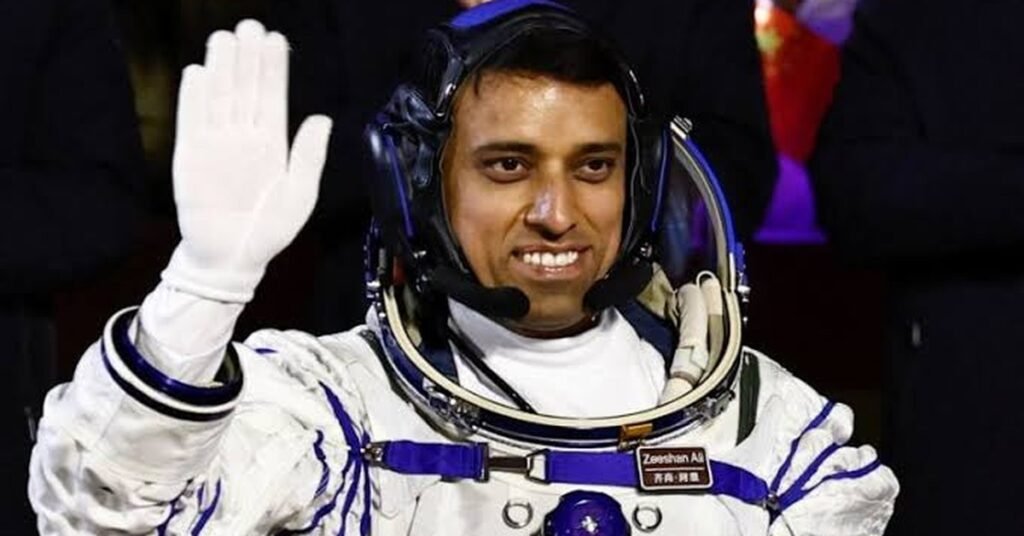
Pakistan is celebrating a historic first this week. Muhammad Zeeshan Ali, a 40-year-old Pakistan Air Force pilot, has become the first Pakistani ever to travel into orbit. On 25 November 2026 he launched on China’s Shenzhou-24 mission, and a few hours later he floated into the Tiangong space station. Notably, he is the first foreign astronaut to ever board China’s station.
From Karachi to Khyber, everyone is talking about him. So, in this HelloSalam guide, we cover who he is, how he got there, what he is doing in space and when he returns. Plus, we share fun ways for Pakistani families to enjoy space and astronomy right here at home.
Who Is Muhammad Zeeshan Ali?
Muhammad Zeeshan Ali is a fighter pilot with the Pakistan Air Force. Reports say he holds the rank of Wing Commander. On Shenzhou-24, he works as the payload specialist, which means his main job is to run science experiments while the Chinese crew flies the spacecraft.
| Fact | Details |
|---|---|
| Full name | Muhammad Zeeshan Ali |
| Age | 40 |
| Profession | Pakistan Air Force fighter pilot |
| Mission | Shenzhou-24 (China) |
| Role | Payload specialist |
| Launch | Wednesday, 25 November 2026, 5:18 AM PKT |
| Launch site | Jiuquan Satellite Launch Centre |
| Crewmates | Commander Tang Hongbo and pilot Wu Yi |
| Destination | Tiangong space station |
| Length of stay | About one week |
How Pakistan Picked Its First Orbital Astronaut
The journey began in February 2025. That month, Pakistan’s space agency SUPARCO signed a cooperation deal with the China Manned Space Agency. As part of it, China agreed to train two Pakistanis, and one of them would fly to Tiangong.
Next came a tough three-stage selection covering medical fitness, psychological strength and technical skills. In April 2026, SUPARCO named Zeeshan Ali and Khurram Daud as its first two astronaut candidates. Shortly before they left, Prime Minister Shehbaz Sharif met both men.
After that, the pair spent about seven months at the Astronaut Centre of China. During that time, they trained on spacecraft systems, emergency drills and zero-gravity tasks. They even learned Chinese so they could talk with mission control and their crewmates.
Launch Day: Pakistan Reaches Orbit
At 5:18 AM Pakistan time on 25 November, a Long March-2F rocket lifted off from Jiuquan in northwest China. As a result, many Pakistanis woke up to the news that their country had finally reached orbit.
Just over six hours later, the Shenzhou-24 capsule docked with Tiangong. Then the crew opened the hatch, and Zeeshan Ali floated into the station. Consequently, he wrote two firsts into the history books: the first Pakistani in orbit and the first international visitor to China’s space station.
What Muhammad Zeeshan Ali Is Doing on Tiangong
During his week in space, Zeeshan is running joint Pakistan-China science. According to the SUPARCO Mission Hub, the four experiments are:
- Hybrid Composite Shield: testing graphene-based materials that could protect astronauts from radiation.
- Self-Healing in Space: checking whether carbon-fibre materials can repair their own damage.
- Quinoa Beyond Earth: studying how quinoa seeds survive microgravity and radiation, which could help grow food in space.
- Green Life Beyond Earth: using microalgae and cyanobacteria to support life on long missions.
In addition, Pakistani universities sent more than 300 research ideas for this mission. Clearly, it has sparked huge interest among students across the country.
Did Zeeshan Ali Go to the Moon?
No, although many people on social media think so. In reality, Tiangong orbits about 400 km above the Earth, while the Moon sits roughly 384,000 km away. So, Zeeshan is in low Earth orbit, not on the lunar surface.
Still, the Moon features in his story. Before launch, he told his family that even though he would be farther from home than ever before, they would still share the same Moon. Moreover, he said he hopes Pakistan and China will one day fly together to the Moon, Mars and beyond.
What He Said Before Launch
Speaking to reporters in China, Zeeshan thanked the Chinese government and said he carried the hopes of 250 million Pakistanis. He also described the mission as a launch pad rather than a finish line. Finally, he shared that the Prime Minister had told him they were about to write a new chapter in Pakistan’s history.
When Will Muhammad Zeeshan Ali Return to Earth?
Zeeshan’s trip is short, about one week in total. After that, he will return home with the crew of Shenzhou-23, so his landing should come in early December 2026. Meanwhile, Tang Hongbo and Wu Yi will stay on the station for around six months.
Typically, Shenzhou crews land in the grasslands of Inner Mongolia in a capsule under a large parachute. After that, recovery teams help the astronauts out, because their bodies need time to readjust to gravity. So, do not be surprised if the first photos show Zeeshan being carried in a chair; that is completely normal after spaceflight.
Once he lands, expect a hero’s welcome. We will update this page as soon as SUPARCO announces any official reception or public event, so bookmark it and check back.
Where to Experience Space and Astronomy in Pakistan
Has the mission inspired your kids, or yourself, to look up at the stars? Fortunately, you do not need a rocket to enjoy space. Here are some easy ideas for families across Pakistan:
- Visit a planetarium: PIA runs planetariums in Karachi, Lahore and Peshawar, where shows explain the solar system and the night sky. Check timings before you go.
- Go stargazing in the north: dark skies in places like Fairy Meadows and Deosai offer amazing views of the Milky Way. For example, our 5-day Fairy Meadows trip guide covers how to get there.
- Plan a winter getaway: clear winter nights in the hills are perfect for spotting stars too. Read our Murree snowfall 2026 guide for timing tips.
- Take the family out this weekend: if you are in Islamabad, the Lok Virsa Mela 2026 is another great day out.
- Support young learners: students who want to study science can benefit from schemes like the PM Youth Chromebook Scheme 2026.
Pakistan in Space: A Short Timeline
Although this mission feels sudden, Pakistan’s space story actually goes back more than 60 years. Here are the key milestones that led to this moment:
| Year | Milestone |
|---|---|
| 1961 | SUPARCO is founded |
| 1962 | Rehbar-I, Pakistan’s first rocket, is launched |
| 1990 | Badr-1 becomes Pakistan’s first satellite |
| 2023 | Namira Salim reaches the edge of space on a suborbital flight |
| 2024 | ICUBE-Q travels to the Moon on China’s Chang’e-6 mission |
| 2025 | SUPARCO and China sign the astronaut agreement |
| 2026 | Muhammad Zeeshan Ali becomes the first Pakistani in orbit |
In other words, the Moon is not completely new territory for Pakistan. In 2024, a small Pakistani satellite called ICUBE-Q flew to the Moon on board a Chinese spacecraft. Now, with a trained astronaut in orbit, Pakistan has taken the next big step in human spaceflight. Hopefully, the next chapter will include even bigger missions, and perhaps one day a Pakistani will walk on the Moon.
Meanwhile, for students, this is the perfect time to get interested in space science. Many universities in Pakistan now offer aerospace, physics and engineering programmes. Moreover, the success of this mission is likely to bring more scholarships, internships and research projects in the coming years.
Why This Mission Matters for Pakistan
Above all, this flight puts Pakistan in a small group of countries that have sent their own astronaut into orbit. It also gives SUPARCO valuable experience in human spaceflight. Most importantly, it shows young Pakistanis that a career in science, engineering or aviation can literally take them to space.
For official photos and updates, visit the SUPARCO Mission Hub. You can also read the full launch report on Dawn.
Frequently Asked Questions
Who is Muhammad Zeeshan Ali?
He is a 40-year-old Pakistan Air Force fighter pilot who became the first Pakistani to reach orbit on 25 November 2026, aboard China’s Shenzhou-24 spacecraft.
Did Muhammad Zeeshan Ali go to the Moon?
No. Instead, he flew to China’s Tiangong space station, which orbits about 400 km above the Earth. The Moon is roughly 384,000 km away. However, he has said he hopes Pakistan and China will travel to the Moon and Mars together one day.
Who was the first Pakistani in space?
Namira Salim reached the edge of space on a suborbital Virgin Galactic flight in October 2023. Muhammad Zeeshan Ali, by contrast, is the first Pakistani to go into orbit and live on a space station.
When will Zeeshan Ali come back to Earth?
His visit lasts about one week. After that, he returns with the Shenzhou-23 crew, so expect his landing in early December 2026.
Who was the second Pakistani astronaut candidate?
Khurram Daud trained in China alongside Zeeshan Ali. Some reports describe him as the backup astronaut.
What experiments is he doing on Tiangong?
SUPARCO lists four joint experiments: a graphene radiation shield, self-healing carbon fibre, quinoa seeds in space and microalgae for life support.
Where can families learn about space in Pakistan?
Planetariums in Karachi, Lahore and Peshawar are a good start. In addition, dark-sky spots in the northern areas are great for stargazing.
Stay with HelloSalam for his return date, any welcome events and more news, events and travel ideas from across Pakistan.


Pingback: PM Youth Chromebook Scheme 2026: Eligibility & How to Apply