
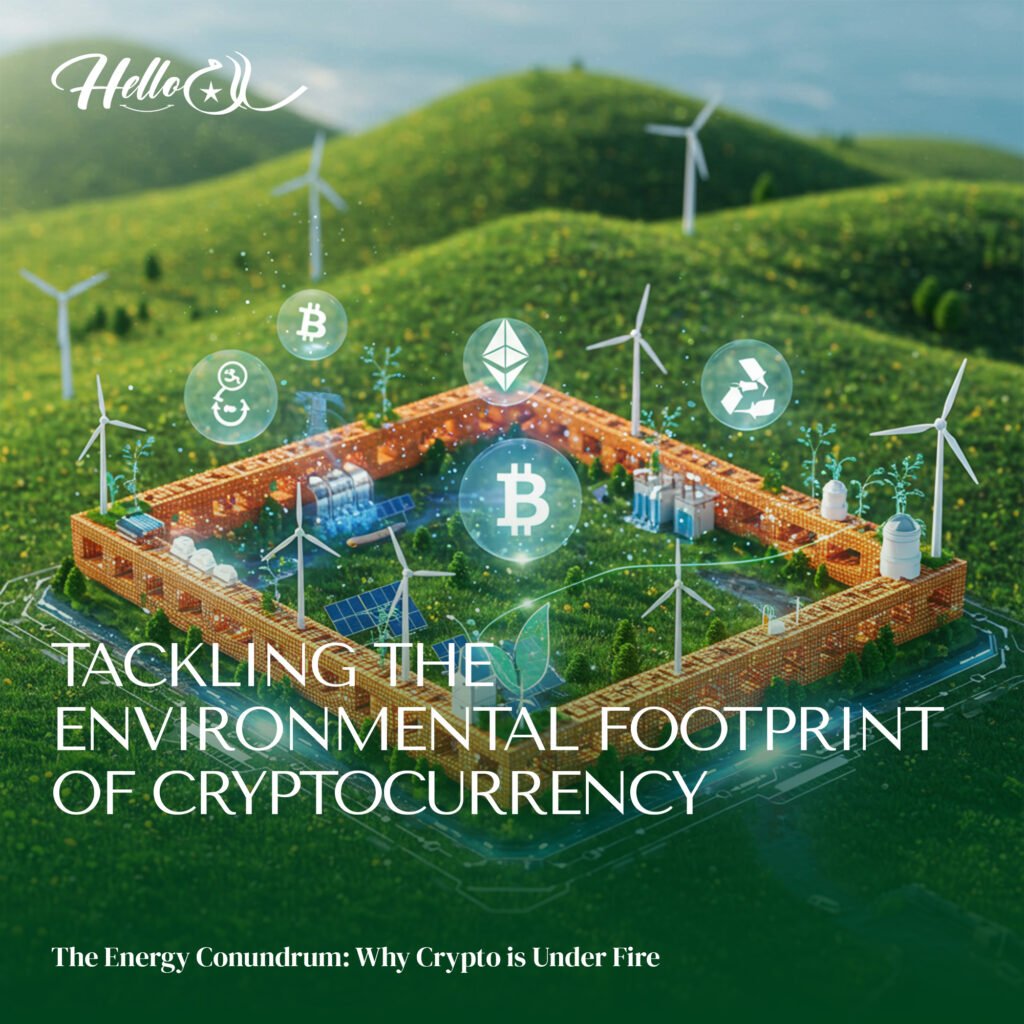
The Green Revolution in Crypto: Understanding and Tackling its Environmental Impact
The world of cryptocurrency has captivated millions, offering innovative financial possibilities and a decentralized future. From digital currencies to NFTs, the blockchain has reshaped how we think about assets and transactions. However, as crypto’s influence grows, so does a critical conversation about its environmental footprint. This isn’t just a technical debate, it’s a timely and important topic that impacts our planet, and understanding it is key to navigating the future of digital finance.

The Energy Conundrum: Why Crypto is Under Fire
At the heart of the environmental discussion lies the energy consumption of certain cryptocurrencies, particularly those using a mechanism called Proof-of-Work (PoW). Bitcoin, the largest and most well-known cryptocurrency, relies on PoW, where powerful computers, known as “miners,” compete to solve complex mathematical puzzles to validate transactions and add new blocks to the blockchain. This process is inherently energy-intensive.
Studies have shown that Bitcoin mining consumes significant amounts of electricity, with estimates placing its annual electricity usage comparable to that of entire nations. The most significant concern is that some blockchains consume too much energy, producing extra greenhouse gases unnecessarily and creating more e-waste. A substantial portion of this energy often comes from fossil fuels, leading to considerable carbon emissions. As of 2025, about half of the electricity used for Bitcoin was generated through fossil fuels, contributing to carbon emissions. The United Nations University (UNU) highlighted that Bitcoin mining is highly dependent on fossil fuels, with worrying impacts on water and land in addition to a significant carbon footprint.
The scale of this energy demand is striking. According to the International Monetary Fund (IMF), crypto mining and data centers now account for 2% of global electricity use and nearly 1% of global emissions, and their footprint is growing. Beyond just energy, there are concerns about the generation of e-waste from rapidly obsolete mining hardware and even local impacts like increased air pollution in areas with concentrated mining operations.

A Greener Horizon: The Rise of Proof-of-Stake and Beyond
The good news is that the cryptocurrency industry is actively addressing these environmental concerns, and significant progress is being made. The most prominent solution emerging is the shift from Proof-of-Work (PoW) to Proof-of-Stake (PoS) consensus mechanisms.
In a Proof-of-Stake system, validators are chosen to create new blocks based on the amount of cryptocurrency they “stake” or commit as collateral, rather than solving complex computational puzzles. This fundamentally changes the energy equation. The difference in energy consumption between PoW and PoS is profound, with PoW networks like Bitcoin consuming over 99% more energy than PoS networks.
The most notable example of this transition is Ethereum, the second-largest cryptocurrency. In September 2022, Ethereum successfully completed “The Merge,” migrating from PoW to PoS. This monumental shift drastically reduced Ethereum’s energy consumption by an astonishing 99.95%, making it one of the most eco-friendly blockchains. Before The Merge, Ethereum’s energy consumption was comparable to that of entire nations, but afterward, it dropped to the equivalent of a small town. This move by Ethereum serves as a powerful testament to the industry’s commitment to sustainability.
Beyond the move to PoS, other initiatives are contributing to a greener blockchain future:
- Renewable Energy Adoption: Many mining operations are increasingly turning to renewable energy sources like solar, wind, hydro, and geothermal power to reduce their carbon footprint. Some Bitcoin miners reported that 29% of their mining is powered by renewables. Countries like Iceland are leveraging abundant hydroelectric and geothermal resources for environmentally responsible crypto mining.
- Carbon Offset Programs: Measures like carbon offset programs are being implemented to mitigate the environmental impact of crypto activities. Blockchain technology is even being leveraged to create transparent and traceable carbon credit markets, allowing individuals and businesses to invest in carbon reduction projects.
- Development of Green Cryptocurrencies: A growing number of cryptocurrencies are designed from the ground up with energy efficiency and sustainability in mind. These “green cryptocurrencies” often utilize PoS or other low-energy consensus mechanisms. Examples include Cardano (ADA), Solana (SOL), Chia (XCH), Tezos (XTZ), Algorand (ALGO), and Stellar (XLM), among others. Chia, for instance, uses a “Proof-of-Space-and-Time” mechanism that consumes significantly less power than Bitcoin.
- Hardware Efficiency: Continuous innovation in mining hardware is leading to more energy-efficient machines, further reducing the power needed per computation.
- Innovative Use Cases: Some projects are even exploring how Bitcoin mining can be used to stabilize energy grids or utilize otherwise wasted energy, for example, by powering remote communities in places like Zambia using excess renewable energy.
Why This Matters: A Global and Local Perspective
The environmental impact of crypto is a global issue, and its solutions require collective effort. For a country like Pakistan, which is highly vulnerable to the impacts of climate change, embracing and promoting sustainable practices in all sectors, including emerging technologies like crypto, is crucial. Supporting the development and adoption of sustainable crypto technologies contributes to a healthier planet for everyone.
The Path Forward: Innovation and Responsibility
While challenges remain, the cryptocurrency industry is demonstrating a strong commitment to sustainability. The shift to Proof-of-Stake, the increasing adoption of renewable energy, and the rise of green cryptocurrencies are all positive indicators. As technology evolves, we can expect even more innovative solutions to emerge, further reducing crypto’s environmental footprint.
The future of crypto is not just about financial innovation, it’s also about responsible innovation. By understanding the challenges and supporting the ongoing efforts towards sustainability, we can collectively work towards a greener, more sustainable crypto future that benefits both our digital economy and our planet.
Stay tuned with Hello Salam PK for more!